

Every week, another health system announces an AI initiative. Every quarter, the same health system quietly admits the pilot never scaled. The AI worked in the demo. It passed the vendor’s benchmark. It even impressed the board. But somewhere between the proof of concept and real clinical value, it fell apart — and no one had a framework rigorous enough to see it coming.
At GenServe.AI, we believe the reason healthcare AI so frequently disappoints is not that the technology is bad. It’s that health systems are evaluating AI at the wrong layer. They invest at Layer 1 and measure at Layer 6, skipping everything in between. The result is a graveyard of expensive pilots that technically “worked” but never actually helped a single patient.
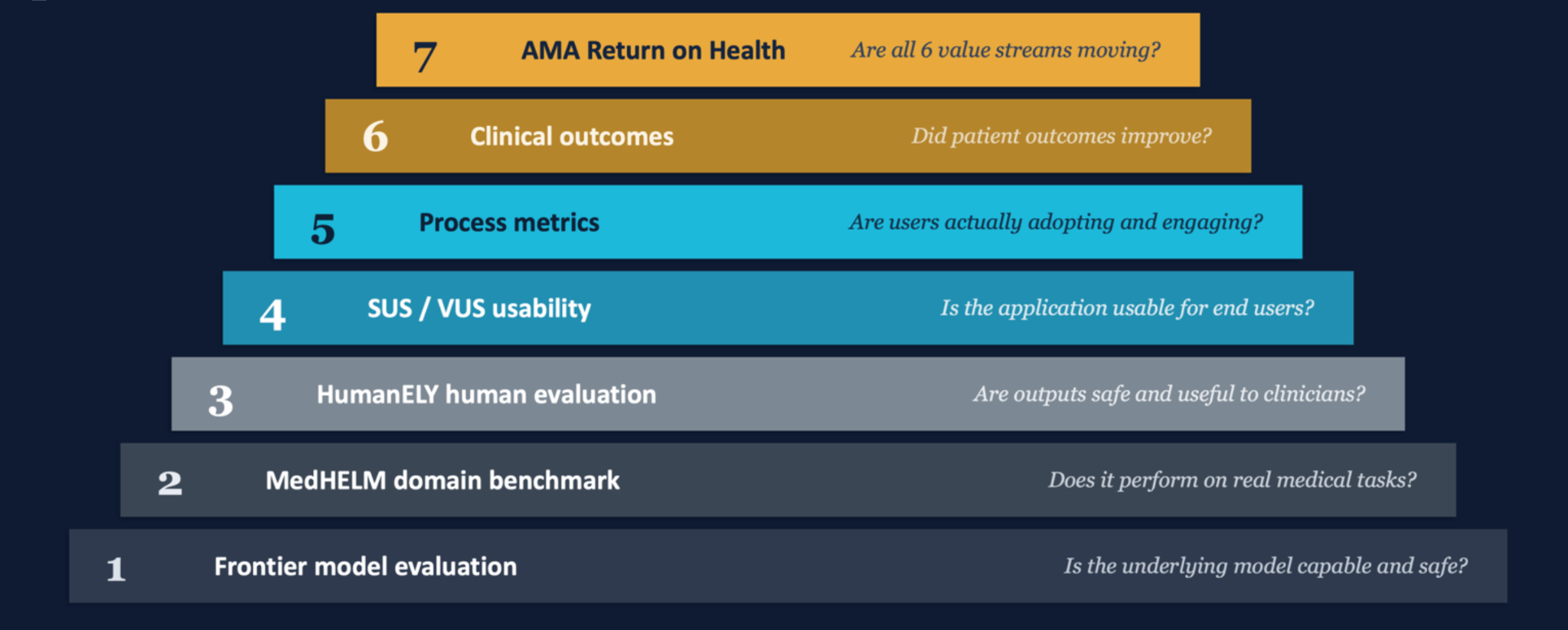
We built our AI validation practice around a seven-layer evaluation framework — a progressive hierarchy that ensures AI is not just capable, but clinically safe, usable, adopted, impactful, and ultimately delivering measurable return across every dimension of organizational health. Here is how each layer works, and why skipping any one of them is a risk no health system can afford.
Building on a rapid, enterprise-wide deployment of GenServe.AI’s HIPAA-compliant Generative AI platform that brings multiple large language models from OpenAI, Anthropic, Google, and AWS within 30 days, NEMS is exploring expansion into voice-first clinical AI agents designed to close thousands of care gaps and transform population health outcomes at scale.
Frontier Model Evaluation: Is the underlying model capable and safe?
Before any healthcare application is built, the foundational AI model powering it must pass rigorous capability and safety evaluation. At GenServe.AI, this means assessing the base model — whether a large language model, computer vision system, or multi-modal architecture — against standardized safety benchmarks, bias inventories, adversarial robustness tests, and hallucination rates. A model that performs brilliantly on general language tasks may fail catastrophically when asked to reason about drug interactions, interpret lab values, or generate clinical documentation. Layer 1 is non-negotiable: no matter how compelling the application, the underlying model must be evaluated for the specific cognitive demands of clinical and administrative healthcare work before a single line of healthcare-specific code is written around it. This is where GenServe.AI applies our vendor-agnostic model evaluation framework, scoring models across medical reasoning, factual accuracy, citation reliability, and behavior under adversarial clinical prompts.
MedHELM Domain Benchmark: Does it perform on real medical tasks?
Passing general safety benchmarks is necessary but not sufficient. The second layer of evaluation measures how the AI model performs on real, validated medical tasks using domain-specific benchmarks like MedHELM — the Holistic Evaluation of Language Models in Medicine developed in collaboration with Stanford CRFM and Google. MedHELM spans dozens of clinical task categories including diagnosis support, medical question answering, clinical note summarization, drug-drug interaction identification, and evidence synthesis. A model can score well on general safety benchmarks and still perform inadequately on the specific medical reasoning tasks your health system needs it to do. GenServe.AI’s validation methodology requires benchmark scores on the MedHELM task categories most relevant to the specific clinical use case under evaluation, ensuring that the AI deployed in your oncology workflow is being measured against oncology-grade tasks — not generic language performance.
Unlike single-vendor AI products, GenServe.AI orchestrates multiple large language models, including those from OpenAI, Anthropic, Google, and AWS — within a secure environment that organizations fully control. No data leakage, shadow AI or vendor lock-in. This builds the foundation for growth and outcomes through Agentic AI Referrals combined with FTE-savings by autonomous care gaps closure with agentic navigation, monitoring and transitions of care.
HumanELY Human Evaluation: Are outputs safe and useful to clinicians?
Benchmarks can tell you how a model performs on standardized tasks. They cannot tell you whether a clinician looking at the model’s output in a real clinical context would find it safe, accurate, and useful. This is the role of HumanELY — a structured human evaluation methodology in which practicing clinicians systematically review AI-generated outputs for clinical accuracy, potential for patient harm, relevance to the clinical question posed, and clarity of expression. At GenServe.AI, we conduct HumanELY evaluations with physician panels drawn from the relevant specialty before any AI tool reaches production. This layer catches the failure modes that benchmarks miss: plausible-sounding but factually incorrect clinical reasoning, outputs that are technically accurate but misaligned with clinical workflow, and recommendations that could be correct on average but dangerous for the specific patient population your system serves. Clinician trust is earned at Layer 3, and it cannot be retrofitted after deployment.
SUS / VUS Usability: Is the application usable for end users?
A clinically validated AI tool that no one can actually use is not a healthcare solution — it is an expensive compliance checkbox. Layer 4 evaluates the usability of the AI application itself using the System Usability Scale (SUS) and its healthcare-adapted variant, the Validated Usability Scale (VUS), measuring whether real end users — physicians, nurses, medical assistants, case managers, and administrative staff — can interact with the tool efficiently, confidently, and with minimal cognitive burden. Healthcare AI usability failures are pervasive and underreported: complex interfaces, alert fatigue from poorly calibrated AI recommendations, outputs embedded in places clinicians never look, and friction that adds time to already overloaded workflows. GenServe.AI conducts SUS/VUS evaluation with representative users from each affected role group before deployment, with a minimum usability threshold required for advancement to production — because an AI tool that reduces efficiency, even slightly, will be abandoned by clinicians regardless of its clinical accuracy.
Process Metrics: Are users actually adopting and engaging?
Deployment is not adoption. Layer 5 measures whether users are actually engaging with the AI tool in clinical and operational practice — tracking utilization rates by role and shift, AI recommendation acceptance and override rates, time-in-workflow metrics, alert response patterns, and longitudinal engagement trends that reveal whether initial curiosity is converting into sustained behavioral change. This is where the majority of healthcare AI programs reveal their quiet failures: tools that appear in dashboards as “deployed” but carry single-digit utilization rates among the clinicians they were built to support. At GenServe.AI, process metrics are monitored continuously from day one of production deployment through our AI Execution Management Office, with utilization thresholds triggering structured intervention — additional training, workflow redesign, or clinical champion engagement — before low adoption hardens into permanent rejection. Without Layer 5 measurement, health systems routinely overestimate the impact of their AI investments by orders of magnitude.
Clinical Outcomes: Did patient outcomes improve?
The question that every health system ultimately needs to answer about every AI investment is deceptively simple: did patient outcomes improve? Layer 6 moves evaluation from process to impact, measuring whether the AI tool is driving the clinical results it was designed to produce — reduced readmissions, faster diagnosis, lower complication rates, improved medication adherence, higher preventive screening completion, shorter length of stay, or better chronic disease management. GenServe.AI requires pre-defined clinical outcome metrics established before deployment, with matched comparison cohorts and minimum observation windows designed to detect statistically meaningful change rather than statistical noise. This layer is where evidence-based AI claims are verified or refuted, and where the distinction between AI that impresses in demos and AI that actually delivers for patients becomes undeniable. Clinical outcomes data also forms the foundation of the ROI narrative that healthcare AI programs must present to boards, payors, and regulators.
AMA Return on Health: Are all six value streams moving?
The highest layer of evaluation asks the broadest and most important question: is the AI initiative generating return across every dimension of organizational health, not just the dimension it was optimized for? The AMA’s Return on Health framework identifies six interconnected value streams that a high-performing health system must advance simultaneously: better clinical outcomes for patients, better patient and family experience, better clinician well-being and reduced burnout, stronger operational and financial performance, reduced administrative burden, and greater health equity across the populations served. Healthcare AI that improves clinical outcomes while burning out the clinicians delivering care, or that reduces costs while widening equity gaps, is not a success — it is a tradeoff the field cannot afford. At GenServe.AI, Layer 7 evaluation requires that every AI initiative in production be assessed across all six AMA value streams on a defined cadence, with executive leadership reviewing the full return profile rather than celebrating single-dimension wins. This is the layer that separates AI programs that transform health systems from AI programs that merely optimize them.
The Framework in Practice: A New Standard for Healthcare AI Accountability
Most healthcare AI vendors will show you Layer 1. The best ones will show you Layer 6. GenServe.AI holds itself and every AI initiative in the health systems we partner with accountable to all seven — because we believe the only AI worth deploying is AI that is safe at the model level, validated on real medical tasks, trusted by clinicians, intuitive for users, actually used in practice, improving patient outcomes, and advancing every dimension of what it means to be a high-performing, equitable health system.
The seven-layer framework is not a checklist. It is a continuous operating standard — a commitment that AI does not earn its place in clinical care through a one-time demonstration, but through ongoing, rigorous, multi-dimensional evidence that it is delivering on the promise that drew every one of us into healthcare in the first place: to make people healthier, and to make the people who care for them better at what they do.
If you are a health system leader evaluating AI investments, we invite you to apply this framework to every tool you are currently considering — and to hold your AI partners accountable to the full hierarchy, not just the layers that are easy to measure. The veterans, patients, and communities you serve deserve nothing less.
As Thanksgiving week comes to a close, we’ve taken time to pause, reflect, and feel immense gratitude for everyone who has been part of GenServe.AI’s journey so far. Our first Thanksgiving as GenServians reminded us just how much we have to be thankful for — the people, partnerships, and shared purpose driving everything we do.
Over the past year, we’ve pushed boundaries, built innovative healthcare AI tools, and envisioned a future where technology helps clinicians work smarter, patients receive better care, and health systems move toward equity and excellence. But what truly defined this year wasn’t just innovation — it was collaboration.
We’re especially grateful to: